Told No, They Built Their Own: The Student-Run Robotics Team That Went From a Garage to the World Championship
Presented by Zippy
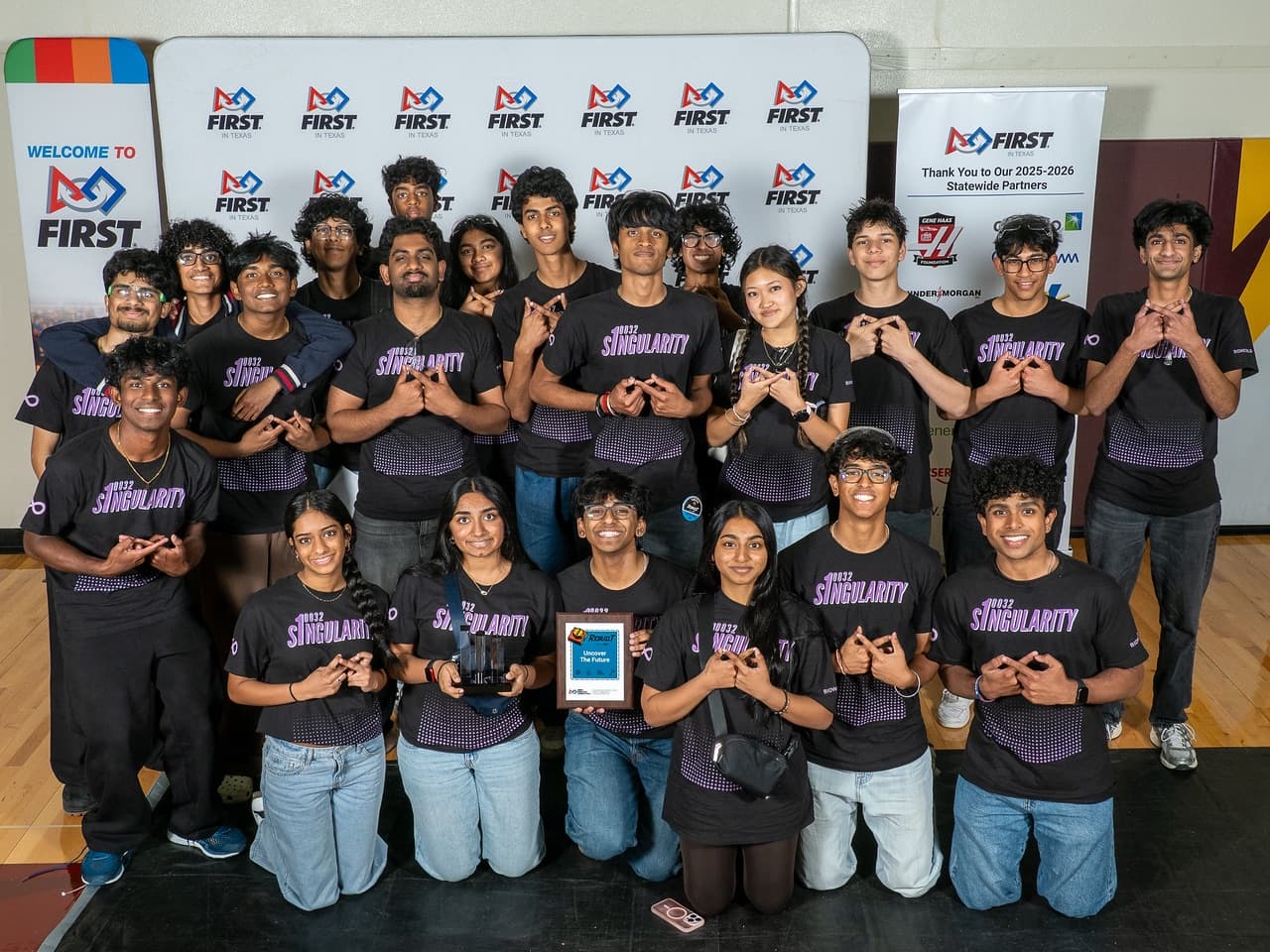
Singularity Robotics was started in 2024 by Frisco students who had been turned away from other robotics teams. Two years later, the entirely student-led team has won a major Texas tournament, has qualified for a World Championship, and runs an outreach program that has so far impacted over 600 local kids.
The team's own description of how it started is seven words long: "Started by students who got told no."
In 2024, a group of Frisco ISD students tried to join established high school robotics teams and were turned away. Instead of waiting for a spot to open up, they started a team of their own. They named it Singularity Robotics.
First, a quick explanation of what a robotics team actually does. Singularity competes in the FIRST Robotics Competition, a worldwide program for high school students. (FIRST is the name of the nonprofit that runs it. It stands for "For Inspiration and Recognition of Science and Technology.") Think of it as a varsity sport for engineering. Every January, all the teams are given the rules of a brand-new game. They then have about six weeks to design, build and program a large robot that can play it. After that come the tournaments, where robots face off in fast matches in front of referees, a scoreboard and a cheering crowd. Every team gets a number. Singularity's is 10032, which you will see on its robot and its shirts.
How They Started
Most teams are run through a high school, with a school workshop and adult engineers guiding the work. Singularity has none of that. The team builds its robots in a student's two-car garage, and when all 36 members cannot fit inside, the work spills out onto the driveway.
The students run everything themselves: designing the robot, building it, writing the software that controls it, raising the money and planning the community events. Recent graduates of the team help with legal paperwork and with rides, but the decisions belong to the students. "No mentors guide our builds. No adults approve our code," the team writes in its season magazine, Horizon. "This is our team, entirely."
Singularity is also its own registered nonprofit organization, not part of any school district. It is open to any student who wants to learn, with or without experience. As Horizon puts it, the founders "built something new: a team that would be entirely student-led, radically inclusive, and driven by a genuine love of engineering and community."
Where They Are Now
It did not take long to show results. In its very first season, in 2025, Singularity won the Rookie All-Star Award, given to the most outstanding first-year team, at a regional tournament in Manor, Texas. It then won the same award again at the Texas state championship. That earned the team a place at the World Championship in Houston.
In 2026, its second season, the team built a new robot named ORION and won its first tournament outright, in Fort Worth. It also won the Team Sustainability Award, for building a team that is set up to last, and the Rising All-Star Award at the state championship, recognizing it as a team on the rise.

What They Do for the Community
The trophies are only part of the story. Much of the team's time goes to getting younger kids excited about science and engineering.
Workshops for Elementary Students
Singularity runs hands-on workshops for local kindergarten through fifth grade students through Frisco Ignite, an education nonprofit founded in 2018 that the team has overseen since 2024. The workshops mix science experiments, small engineering challenges and a lot of marble runs. In the first year alone they reached more than 600 local kids. "We saw first-graders debug a marble run and feel like engineers," the team writes. The program has been recognized by the city, too: Frisco Ignite holds a City of Frisco Certificate of Recognition signed by Mayor Jeff Cheney.
Coaching Younger Teams
Robotics has junior leagues too, including one where elementary and middle schoolers build robots out of LEGO. Singularity members coach two of those local LEGO teams. They also helped a brand-new robotics team at Frisco's Wakeland High School through its first season, which ended with a runner-up finish at the state level. Singularity is quick to point out whose trophies those are. "We didn't win those; Wakeland did," the team writes. "But when students invest in other students, this is what happens."
Science Kits for Kids in the Hospital
Singularity partners with and helps oversee STEMSeeds, a nonprofit started by Frisco high schoolers. (STEM is short for science, technology, engineering and math.) STEMSeeds delivers hands-on activity kits, each with a paper rocket, a small catapult and a paper robotic hand, to children in hospitals and in underserved communities. So far it has delivered more than 685 kits and has grown to 36 chapters in six countries.
Arcade Games, Built From Scratch
Each season, the students create an original video game in the blocky, retro style of 1980s arcade games, based on that year's robotics challenge. Then they build a full-size arcade machine by hand to put it in, doing the woodworking, wiring, joysticks and painted artwork themselves. The first game, Algae Abyss, was made in two weeks. It became a way to teach coding, then a tournament that raised $500 for local charities, and then a recruiting tool: 25 new members joined the team for the following season. The second game, Fuel Frenzy, travels to tournaments and workshops, and the plan is to install it at the local library. The team estimates about 6,500 people have played the two games.

A Children's Book
The students also published "That's Not Peanut Butter!", written by Adiv Padgilwar and illustrated by Ananya Ramanan. It explains to young readers how computers learn, through a boy named Bob and a robot friend who keeps getting his sandwich wrong. All profits are donated to support gifted and talented education in Prosper ISD.
How It All Gets Paid For
With no school behind it, the team pays its own way through fundraising and sponsors. It estimates a season costs about $46,000, which covers tournament entry fees, robot parts, travel and its community programs. Its supporters include NASA, Raising Cane's, Techie Factory, the Texas Workforce Commission, the Gene Haas Foundation, Raytheon, Texas Instruments and Bioworld, and now Zippy (zippydoes.com), the Frisco home services company behind Frisco Famous.
What's Next
The team's third season begins in January, when the next game is revealed. Until then, the students are focused on growing their community programs.
"We're continuing to look for ways to introduce more students to STEM and robotics while growing what we can offer through Singularity," said Ishaan Thakur, a member of the team's business group.
You can follow the team on Instagram at @singularityfrc. To learn more, join the team or become a sponsor, visit singularity-frc.com.
Photos courtesy of Singularity Robotics, FRC Team 10032.